The Infodengue–Mosqlimate Dengue Challenge (IMDC) is an international scientific initiative designed to improve dengue outbreak forecasting in Brazil using computational models and integrated datasets. IMDC is a collaborative data science experiment applied to public health, bringing together epidemiological, environmental, demographic, and climate data to develop predictive models based on different methodological approaches. These models aim to support decision-making and strengthen dengue surveillance and control strategies. The challenge operates as a modeling sprint, in which teams of researchers develop models to estimate the expected number of dengue cases for the upcoming season in selected cities and states across Brazil. The main objectives of IMDC are:
- To build an international community of dengue modelers
- To develop and compare different predictive modeling approaches
- To create ensemble models that combine forecasts from multiple teams
- To continuously evaluate and improve model performance
History
The first edition of the Infodengue–Mosqlimate Dengue Challenge (IMDC) was organized by the InfoDengue and Mosqlimate projects in 2024 and introduced the Dengue Forecast Sprint format. This inaugural edition brought together research teams to develop dengue forecasting models for Brazil. A total of six teams participated, contributing eight predictive models. During this edition, a framework was established for the standardized submission of forecasts via GitHub, as well as a methodology for building ensemble models that combine forecasts from multiple teams. The second edition of the IMDC, held in 2025, significantly expanded the scale of the challenge and strengthened international collaboration. This edition involved 15 research teams, contributing 19 different predictive models and bringing together a total of 52 researchers. In both challenges, the main outcome was the prediction of the weekly number of dengue cases by Brazilian state. To evaluate model performance, three retrospective validation tests were defined using historical data from 2010 to 2025, followed by a final real-time forecasting target. The Mosqlimate team also developed a collective ensemble model, combining forecasts from multiple teams to improve the accuracy and robustness of dengue predictions in Brazil. Among the main achievements of the 2024 and 2025 IMDC editions are:
- Establishment of a collaborative framework for multi-team forecasting
- Development and improvement of a data infrastructure and standardized model submission system
- Development and evaluation of dengue forecasting methodologies
- Creation of evaluation methods and metrics to assess predictive model performance
- Development and refinement of ensemble models that combine forecasts from multiple teams
Dissemination
The two challenges brought together institutions from several countries, including Brazil, the United States, the United Kingdom, Germany, Italy, Spain, Saudi Arabia, and South Africa. Results were disseminated through several events and publications:
- Validation results webinar
- International webinar (2025)
- Technical reports (in Portuguese) published in 2024 and 2025
- Scientific article describing the methodology and results:
- Preprint version: https://doi.org/10.1101/2025.05.12.25327419
- Peer-reviewed publication (PNAS): https://www.pnas.org/doi/10.1073/pnas.2508989123
Impact
The IMDC has contributed to:
- The development of more robust epidemiological forecasting tools
- Improved support for public health decision-making
- Strengthening international collaboration in infectious disease modeling
3rd IMDC edition
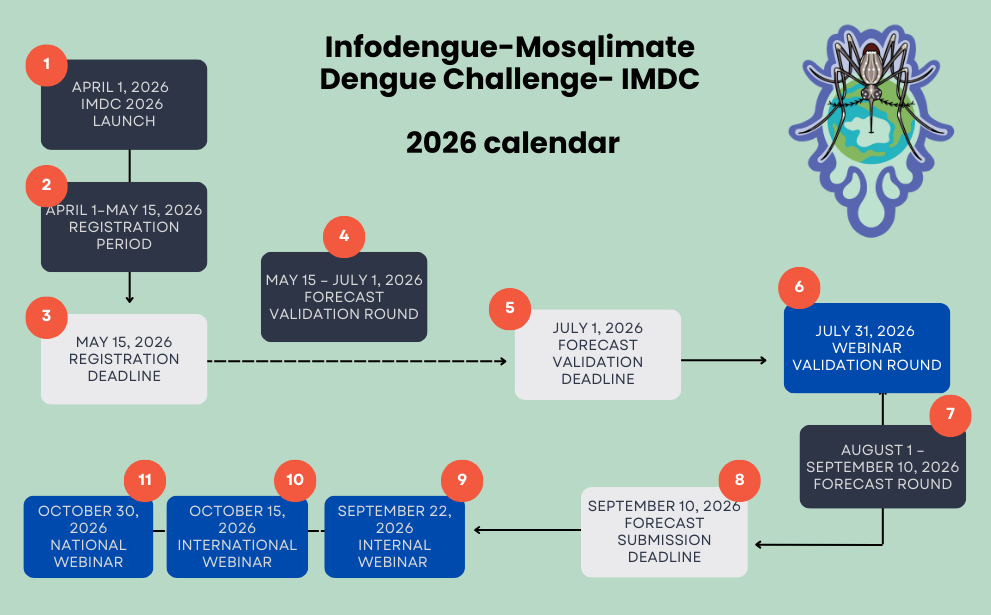
Registration for this year’s edition opens on April 1, 2026. To participate, visit the Registration page. Detailed information about the challenge can be found on the Instructions page. The full schedule of dates for this edition is provided below.
Important dates:
- April 1, 2026 – Challenge launch and opening of team registrations.
- May 15, 2026 – Deadline for team registration.
- July 1, 2026 – Submission deadline for validation round results.
- July 31, 2026 – Webinar: Presentation of validation round results.
- September 10, 2026 – Submission deadline for 2026–2027 forecasts.
- September 22, 2026 – Internal webinar for teams to present model methodologies.
- October 15, 2026 – International webinar: Technical results of IMDC 2026.
- November 06, 2026 – International webinar: IMDC 2026 results for the general audience.
Blogs
Official launch of 2026 3rd IMDC
Anticipating Epidemics: The 3rd InfoDengue–Mosqlimate Dengue Challenge (IMDC)
Dengue is a disease influenced by multiple factors, ranging from climatic conditions to urban dynamics and population mobility. Modeling its spread therefore requires an integrative approach that leverages historical epidemioloical data, climate variables (temperature, precipitation, humidity), socio-environmental indicators, and advanced statistical methods.
In a global scenario marked by the increasing incidence of arboviral diseases, the ability to accurately forecast dengue outbreaks has become one of the major challenges in contemporary public health. It is within this context that the 3rd InfoDengue–Mosqlimate Dengue Challenge (IMDC) emerges—an initiative that brings together data science, epidemiology, and international collaboration to advance predictive modeling of arboviruses. Organized under the Mosqlimate project in partnership with the Infodengue platform, the IMDC offers an open and collaborative environment where multidisciplinary teams can develop, test, and compare models capable of anticipating dengue epidemiological patterns. The proposal goes beyond a competition: it is a collective effort to transform data into actionable knowledge.