Data documentation - 3rd IMDC
This section provides detailed documentation of the data available for the 3rd IMDC, including table descriptions and other essential information for data analysis and modelling.
The data were uploaded to an FTP server. There are several ways to access the data on an FTP server. We will propose some here:
1- Using FileZilla
- Download the FileZilla app from the official website: https://filezilla-project.org/.
- Open the application, enter
info.dengue.mat.brin the Host field, and click the button to connect.

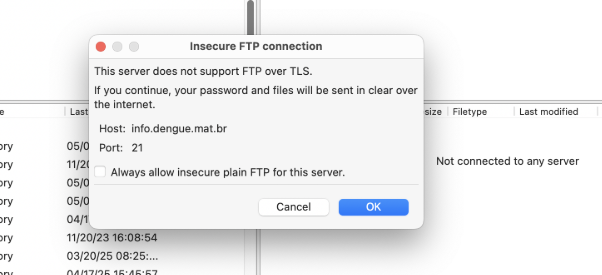
If the message below appears to you, just click ok:
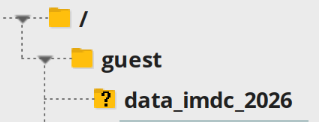
- Open the
data_imdc_2026folder to visualize the available datasets.
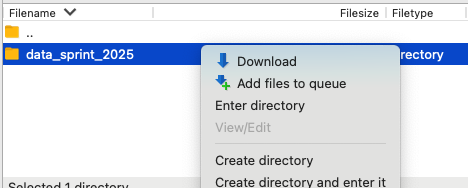
- To download all the datasets in the folder (described in detail in this document) right-click on the folder and click on the Download option:
2 - Using FTPWeb
- Open the link: https://www.ftpweb.com.br/index2.php and fill server= info.dengue.mat.br, user = anonymous and password= anonymous@domain.com.

- Open the
data_imdc_2026folder to visualize the available datasets and download them.
Inside the data_imdc_2026 folder, there are the following files:
- Population: datasus_population_2001_2025.csv.gz,
- Environmental: environ_vars.csv.gz,
- Ocean temperature indicators: enso.csv.gz, iod.csv.gz, pdo.csv.gz,
- Shapefile of the cities: shape_muni.gpkg,
- Shapefile of the regional health divisions: shape_regional_health.gpkg,
- Shapefile of the macroregional health divisions: shape_macroregional_health.gpkg,
- Link between each city and its regional and health region and macroregion: map_regional_health.csv,
- Weekly time series of dengue cases: dengue.csv.gz,
- Weekly time series of chikungunya cases: chikungunya.csv.gz,
- Weekly time series of climatic variables: climate.csv.gz.
- Monthly time series of climate variable forecasts: climate_forecast.csv.gz.
- Daily medical doctors accesses to dengue-related content in the Afya Whitebook application: access_afya_dengue_2021_2026.csv.gz.
Each of these datasets is described in detail below.
Dengue data
Period: epiweek 201001 to epiweek 2026101.
Aggregation: Dengue cases aggregated by the epidemiological week of dengue symptom onset and by municipality.
File: dengue.csv.gz.
Sources: from SINAN and IBGE, organized by Infodengue.
Note: Data from the state of ES may contain inaccuracies due to issues in the reporting process.
Table 1. Description of the columns in dengue.csv.gz
| Column name | Type | Description |
|---|---|---|
| date | YYYY-MM-DD | First day of the epiweek (Sunday). |
| epiweek | int (YYYYWW) | Epidemiological week is defined by the date of symptom onset. |
| geocode | int | IBGE’s municipality code. |
| casos | int | Number of cases per week, classified as probable dengue cases2. This column is equivalent to the column casprov in the infodengue table available in the mosqlimate API. |
| regional_geocode3 | int | Health district code. |
| macroregional_geocode3 | int | Health macroregion code. |
| uf | str | Federative Unit (state). |
| uf_code | int | Two-digit code associated with the Federative Unit (state). This value is required to submit predictions to the Mosqlimate platform. |
| target_city | bool | Boolean flag indicating whether the row corresponds to one of the cities selected for the additional challenge in the 3rd IMDC edition. |
| train_1 | bool | Data for the first training (pre-season 22/23). |
| train_2 | bool | Data for the second training (pre-season 23/24). |
| train_3 | bool | Data for the third training (pre-season 24/25). |
| train_4 | bool | Data for the fourth training (pre-season 25/26). |
| target_1 | bool | Data for the first validation (season 22/23). |
| target_2 | bool | data for the second validation (season 23/24). |
| target_3 | bool | data for the third validation (season 24/25). |
| target_4 | bool | data for the fourth validation (season 25/26). This column does not go up to epiweek 202640 as this data has not yet been reported. However, please send the forecasts for the whole period ([EW 41 2025- EW40 2026]), since by the end of the challenge, the data will be reported, and the forecasts can be evaluated. |
| disease | str | filled with the value dengue |
Chikungunya data
Period: epiweek 201401 to epiweek 2026101.
Aggregation: Chikungunya cases aggregated by the epidemiological week of dengue symptom onset and by municipality.
File: chikungunya.csv.gz.
Sources: from SINAN and IBGE, organized by Infodengue.
Note: Data from the state of ES may contain inaccuracies due to issues in the reporting process.
Table 1. Description of the columns in chikungunya.csv.gz
| Column name | Type | Description |
|---|---|---|
| date | YYYY-MM-DD | First day of the epiweek (Sunday). |
| epiweek | int (YYYYWW) | Epidemiological week is defined by the date of symptom onset. |
| geocode | int | IBGE’s municipality code. |
| casos | int | Number of cases per week, classified as probable dengue cases2. This column is equivalent to the column casprov in the infodengue table available in the mosqlimate API. |
| regional_geocode3 | int | Health district code. |
| macroregional_geocode3 | int | Health macroregion code. |
| uf | str | Federative Unit (state). |
| uf_code | int | Two-digit code associated with the Federative Unit (state). This value is required to submit predictions to the Mosqlimate platform. |
| target_city | bool | Boolean flag indicating whether the row corresponds to one of the cities selected for the additional challenge in the 3rd IMDC edition. |
| train_1 | bool | Data for the first training (pre-season 22/23). |
| train_2 | bool | Data for the second training (pre-season 23/24). |
| train_3 | bool | Data for the third training (pre-season 24/25). |
| train_4 | bool | Data for the fourth training (pre-season 25/26). |
| target_1 | bool | Data for the first validation (season 22/23). |
| target_2 | bool | data for the second validation (season 23/24). |
| target_3 | bool | data for the third validation (season 24/25). |
| target_4 | bool | data for the fourth validation (season 25/26). This column does not go up to epiweek 202640 as this data has not yet been reported. However, please send the forecasts for the whole period ([EW 41 2025- EW40 2026]), since by the end of the challenge, the data will be reported, and the forecasts can be evaluated. |
| disease | str | filled with the value chikungunya |
Climate — reanalysis
Reanalysis of hourly data from ERA5, summarized by week by the Mosqlimate project.
Period: epiweek 199952 to epiweek 2026114.
Aggregation: temperature, humidity, and precipitation, originally by hour, were first aggregated by day (min, max, mean), and these daily measures were aggregated by epidemiological week (mean).
File: climate.csv.gz.
Sources: Copernicus ERA5, organized by Mosqlimate.
Table 2. Description of the columns of climate.csv.gz. The daily values of these variables are available in the mosqlimate API. *Atmospheric pressures are given as if the place were at sea level.
| Column name | Type | Description |
|---|---|---|
| date | YYYY-MM-DD | First day of the epiweek (Sunday). |
| epiweek | int (YYYYWW) | Epidemiological week. |
| geocode | int | IBGE’s municipality code. |
| temp_min | float (°C) | Minimum temperature. |
| temp_med | float (°C) | Mean temperature. |
| temp_max | float (°C) | Maximum temperature. |
| precip_min | float (mm/h) | Minimum precipitation rate. |
| precip_med | float (mm/h) | Average precipitation rate. |
| precip_max | float (mm/h) | Maximum precipitation rate. |
| precip_tot | float (mm) | Total precipitation. |
| pressure_min | float (atm) | Minimum daily sea level atmospheric pressure*. |
| pressure_med | float (atm) | Average atmospheric pressure*. |
| pressure_max | float (atm) | Maximum atmospheric pressure*. |
| rel_humid_min | float (%) | Minimum relative humidity. |
| rel_humid_med | float (%) | Average relative humidity. |
| rel_humid_max | float (%) | Maximum relative humidity. |
| thermal_range | float (°C) | Difference between the daily maximum and minimum temperature averaged by week |
| rainy_days | int | Number of days in the week for which precip\_tot > 0.03. |
Climate Forecast
Seasonal forecasts (up to six months ahead) of climate variables from Copernicus, generated using System 51 by the ECMWF center.
Period: January 2010–March 2026.
File: climate_forecast.csv.gz.
Sources: Copernicus.
Table 3. Description of the columns of climate_forecast.csv.gz.
| Column name | Type | Description |
|---|---|---|
| geocode | int | IBGE’s municipality code. |
| reference_month | YYYY-MM-DD | Reference month. |
| forecast_months_ahead | int | The number of months into the future relative to the reference month for which the forecast is made. |
| temp_med | float (°C) | Mean temperature. |
| precip_tot | float (mm) | Total precipitation. |
| rel_humid_med | float (%) | Average relative humidity. |
Ocean temperature and level oscillations
Period: 1993-01-03 — 2026-05-10 (weekly).
File: ocean_climate_oscillations.csv.gz.
Sources: https://sealevel.jpl.nasa.gov/.
Table 4. Description of the columns of ocean_climate_oscillations.csv.gz.
Note: The dates provided in the original data source were reported on Mondays or Tuesdays and were subsequently shifted to Sundays to ensure temporal alignment with the epidemiological case data. For weeks with missing observations, the corresponding indicator values were imputed using a last-observation-carried-forward approach, whereby each missing value was replaced with the most recent available value from the preceding week.
| Column name | Type | Description |
|---|---|---|
| date | YYYY-MM-DD | First day of the epiweek (Sunday). |
| epiweek | int (YYYYWW) | Epidemiological week. |
| enso | float | El Niño-Southern Oscillation is a climate pattern in the Pacific Ocean that has two phases: El Niño and La Niña. In a normal year, in the Pacific Ocean, the trade winds blow westward along the Equator and push warm surface waters near Australia and Indonesia. On the other side of the Pacific Ocean, nutrient-rich cold waters come up off the coast of Central and South America, creating favorable conditions for fishing. During an El Niño event, the trade winds weaken, and warm, nutrient-poor waters are not pushed anymore by the winds, and sea level rises in the eastern tropical Pacific and falls in the western tropical Pacific. La Niña is the opposite phase of El Niño, with warm water piling up in the western Pacific and colder water in the eastern Pacific. This causes a higher sea level in the western tropical Pacific and a lower sea level in the eastern tropical Pacific. |
| iod | float | The Indian Ocean Dipole. Is a climate pattern affecting the Indian Ocean. During a positive phase, warm waters are pushed to the Western part of the Indian Ocean, while cold deep waters are brought up to the surface in the Eastern Indian Ocean. This pattern is reversed during the negative phase of the IOD. |
| pdo | float | The Pacific Decadal Oscillation PDO. It is a long-term (10-20 year) oscillation of the Pacific Ocean in response to the changes in the atmosphere. During a warm (positive) phase, the response of the ocean to low atmospheric pressure over the Aleutian Islands causes ocean currents to bring warm waters in the Eastern Pacific Ocean and along the coast of North America, and cool nutrient-rich waters in the western Pacific Ocean. This leads to higher sea levels along the coastlines of the Northeast Pacific. During a cool (negative) phase, the Eastern Pacific Ocean becomes cooler and the Western Pacific Ocean becomes warmer. This leads to lower sea levels along the coastlines of the Northeast Pacific. |
Environmental data
Environmental characteristics of the municipalities. Other variables can be aggregated as necessary.
Period: 2010 (koppen) and 2024 (biome).
File: environ_vars.csv.gz.
Sources: IBGE, Embrapa.
Table 5. Description of the columns of environ_vars.csv.gz.
| Column name | Type | Description |
|---|---|---|
| geocode | int | IBGE’s municipality code. |
| uf_code | int | IBGE’s state code. |
| koppen | str | main climate type |
| biome | str | main biome type . |
Demographic data
Table 6. Geometry of cities in shape_muni.gpkg (source = IBGE).
| Column name | Type | Description |
|---|---|---|
| geocode | int | IBGE’s municipality code. |
| geocode_name | str | Municipality name. |
| uf | str | Two-letter state name. |
| uf_code | int | IBGE’s state code. |
| geometry | geometry | municipality geometry. |
Table 7. Geometry of the regional health divisions in shape_regional_health.gpkg (source = DATASUS).
| Column name | Type | Description |
|---|---|---|
| regional_geocode | int | Regional health code. |
| regional_name | str | Regional health name. |
| uf_code | int | IBGE’s state code. |
| geometry | geometry | Regional health geometry. |
Table 8. Geometry of the macroregional health divisions in shape_macroregional_health.gpkg (source = DATASUS).
| Column name | Type | Description |
|---|---|---|
| macroregional_geocode | int | Macrorregional health code. |
| macroregional_name | str | Macrorregional health name. |
| uf | str | Two-letter state name. |
| uf_code | int | IBGE’s state code. |
| geometry | geometry | Macroregional health geometry. |
Table 9. Link between each city and its regional and macroregional health center in map_regional_health.csv (source = IBGE).
| Column name | Type | Description |
|---|---|---|
| macroregion_code | int | Macroregion code (1- Norte, 2- Nordeste, 3- Sudeste, 4 -Sul, 5 - Centro-Oeste). |
| macroregion_name | str | Macroregion name. |
| uf_code | int | IBGE’s state code. |
| uf | str | Two-letter state name. |
| uf_name | str | State name. |
| macroregional_geocode | int | Macrorregional health code. |
| macroregional_name | str | Macrorregional health name. |
| regional_geocode | int | Regional health code. |
| regional_name | str | Regional health name. |
| geocode | int | IBGE’s municipality code. |
| geocode_name | str | Municipality name. |
Table 10. Population data (source: SVS). Files with population by city and year (2001 - 2025) in datasus_population_2001_2025.csv.gz
| Column name | Type | Description |
|---|---|---|
| geocode | int | IBGE’s municipality code. |
| year | int | Year (YYYY) |
| population | int | Population of the city. |
Afya application data
This dataset was provided by Afya and contains the daily number of accesses made by medical doctors to dengue-related content within the Afya Whitebook application.
Period: Daily data between ‘2021-01-01’ and ‘2026-05-31’.
Aggregation: The daily number of accesses by municipality.
File: access_afya_dengue_2021_2026.csv.gz.
Sources: Afya Whitebook application.
Table 11. Description of the columns in access_afya_dengue_2021_2026.csv.gz
| Column name | Type | Description |
|---|---|---|
| access_date | YYYY-MM-DD | Date of access. |
| accessed_topic | str | Topic accessed. |
| geocode | int | IBGE’s municipality code. |
| uf | str | Federative Unit (state). |
| access_count | int | Number of accesses to the topic. |
Additional datasets
REGIC: The publication Regiões de Influência das Cidades 2018 presents the research conducted to identify the hierarchy and areas of influence of Brazilian cities, describes the general characteristics of the detected urban network, and includes thematic analyses to highlight specific features of cities within this network. Available here: https://www.ibge.gov.br/geociencias/cartas-e-mapas/redes-geograficas/15798-regioes-de-influencia-das-cidades.html.
EPISCANNER: This dataset contains estimates of the epidemiological parameters of reproduction number, peak week, epidemic duration, and size of the epidemic for all the Brazilian cities between 2010 and 2025. The methodology to obtain these estimates is available here: https://arxiv.org/abs/2407.21286. There is a dashboard showing the estimates: https://info.dengue.mat.br/epi-scanner/, and this data can be downloaded using the mosqlimate API: https://api.mosqlimate.org/docs/datastore/GET/episcanner/.
NVDI (Normalized Difference Vegetation Index) from BDC (Brazil Data Cube): The BDC is a research, development, and technological innovation project of the National Institute for Space Research (INPE), Brazil. It is producing data sets from big volumes of medium-resolution remote sensing images for the entire national territory and developing a computational platform to process and analyze these data sets using artificial intelligence, machine learning, and image time series analysis. It has your library to get the images. A tutorial to get an image in Python and process it (based on a bbox region) is available here: https://github.com/brazil-data-cube/code-gallery/blob/master/jupyter/Python/stac/stac-image-processing.ipynb. There is also this tutorial: https://github.com/brazil-data-cube/code-gallery/blob/master/jupyter/Python/wtss/wtss-introduction.ipynb explaining how to retrieve a time series of these indicators for a specific latitude and longitude coordinates.
Note that the last weeks are subject to update as cases are still being reported. This data will be updated before the submission of the 2026 forecasts. ↩︎ ↩︎
Case definition: Probable cases = Suspected cases - discarded cases. ↩︎ ↩︎
Regional and Macroregional are the subdivisions used by the Ministry of Health. ↩︎ ↩︎ ↩︎ ↩︎
This data will be updated before the submission of the 2026 forecasts. ↩︎