Instructions - 3rd IMDC
The Infodengue–Mosqlimate Dengue Challenge (IMDC) is an international collaborative initiative focused on developing predictive models for dengue outbreaks in Brazil. Researchers and teams from different fields such as epidemiology, data science, statistics, and mathematical modeling are invited to participate by submitting forecasts based on open datasets provided by the organizers. In this year’s edition, in addition to the traditional dengue forecasting challenge at the state level (UF), three optional challenges are introduced:
- Mandatory Challenge – Dengue (State Level): Forecast dengue cases at the state (UF) level for all Brazilian states, except Espírito Santo.
- Optional Challenge 1 – Dengue (City Level): Forecast dengue cases for 15 selected cities.
- Optional Challenge 2 – Chikungunya (State Level): Forecast chikungunya cases at the state (UF) level for all Brazilian states, except Espírito Santo.
- Optional Challenge 3 – Chikungunya (City Level): Forecast chikungunya cases for 10 selected cities.
You must complete the mandatory challenge. Optional challenges are voluntary. Further details about each challenge are provided below.
1. Team registration
Participants must form a research team and register for the challenge through the registration section of the website. Teams may include researchers from different institutions and countries.
2. Data access
The training datasets will be available for download on an FTP server provided by the Mosqlimate platform. More information can be found in the Data section. The dataset used in the challenge includes primarily:
- dengue and chikungunya epidemiological data
- climate data
- demographic data
These data will be used to train and validate forecasting models. Participants are also welcome to explore the Mosqlimate data API to retrieve specific subsets of data. Additional data sources may be used, provided they are shared with other participants through the organizers. Any additional datasets must be open-access, regularly updatable, and available for all Brazilian states.
3 - Geographic scope of the challenges
Participants must submit forecasts for all geographic units within each challenge they choose to participate in.
- The mandatory challenge must always be completed.
- Participation in optional challenges is voluntary, but if selected, submissions must be complete.
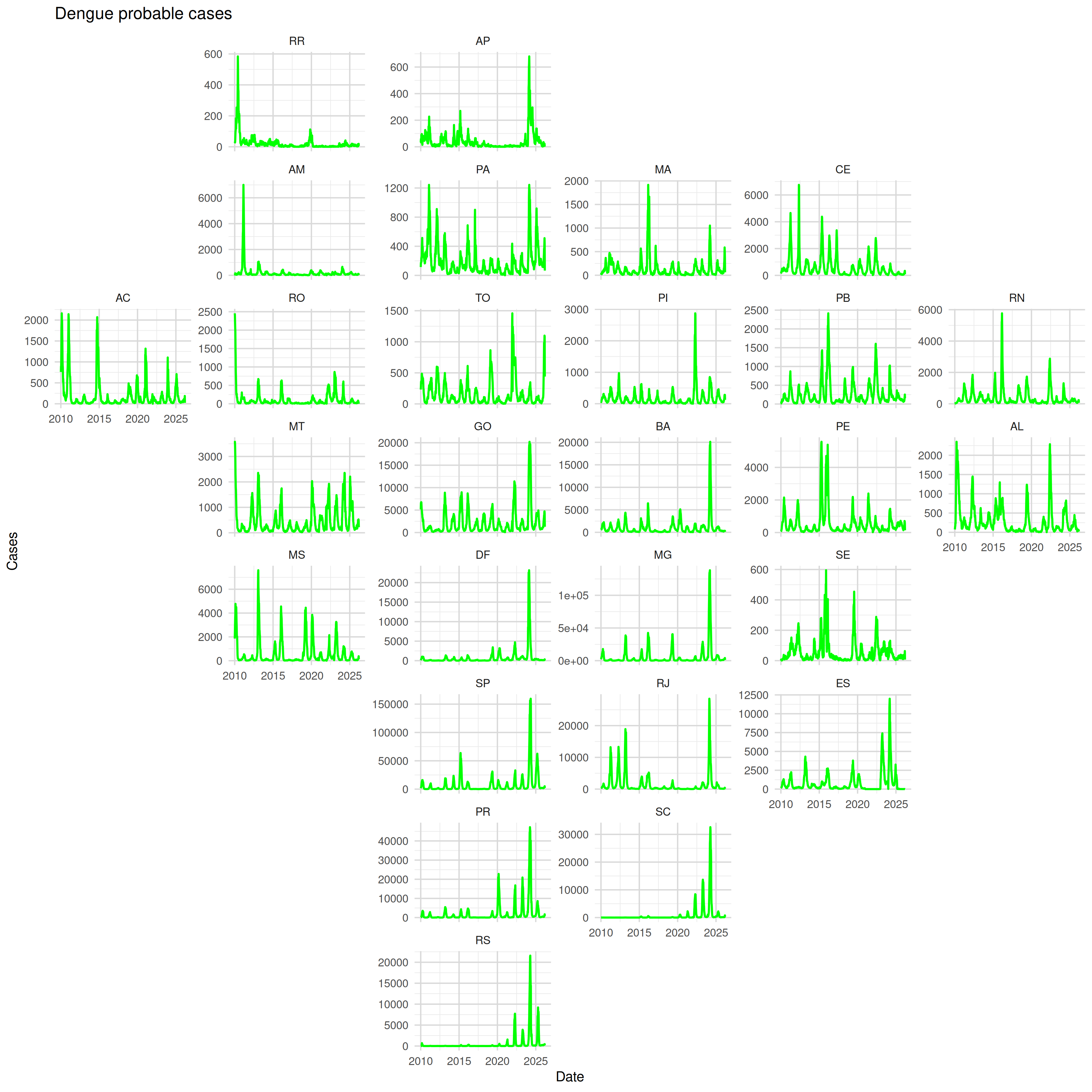
Mandatory Challenge – Dengue (State Level)
Forecast dengue cases at the state (UF) level for all Brazilian states, except Espírito Santo.
Optional Challenge 1 – Dengue (City Level)
Forecast dengue cases for 15 selected citiesfollowing cities:
- Teixeira de Freitas (BA) - geocode: 2931350
- Vitória da Conquista (BA) - geocode: 2933307
- Brejo Santo (CE) - geocode: 2302503
- Coronel Fabriciano (MG) - geocode: 3119401
- São José do Rio Preto (SP) - geocode: 3549805
- Presidente Prudente (SP) - geocode: 3541406
- Rio Branco (AC) - geocode: 1200401
- Cruzeiro do Sul (AC) - geocode: 1200203
- Paraíso do Tocantins (TO) - geocode: 1716109
- Londrina (PR) - geocode: 4113700
- Cambé (PR) - geocode: 4103701
- Cascavel (PR) - geocode: 4104808
- Aparecida de Goiânia (GO) - geocode: 5201405
- Campo Novo do Parecis (MT) - geocode: 5102637
- Novo Gama (GO) - geocode: 5215231
The figure below shows the time series of dengue cases for these cities: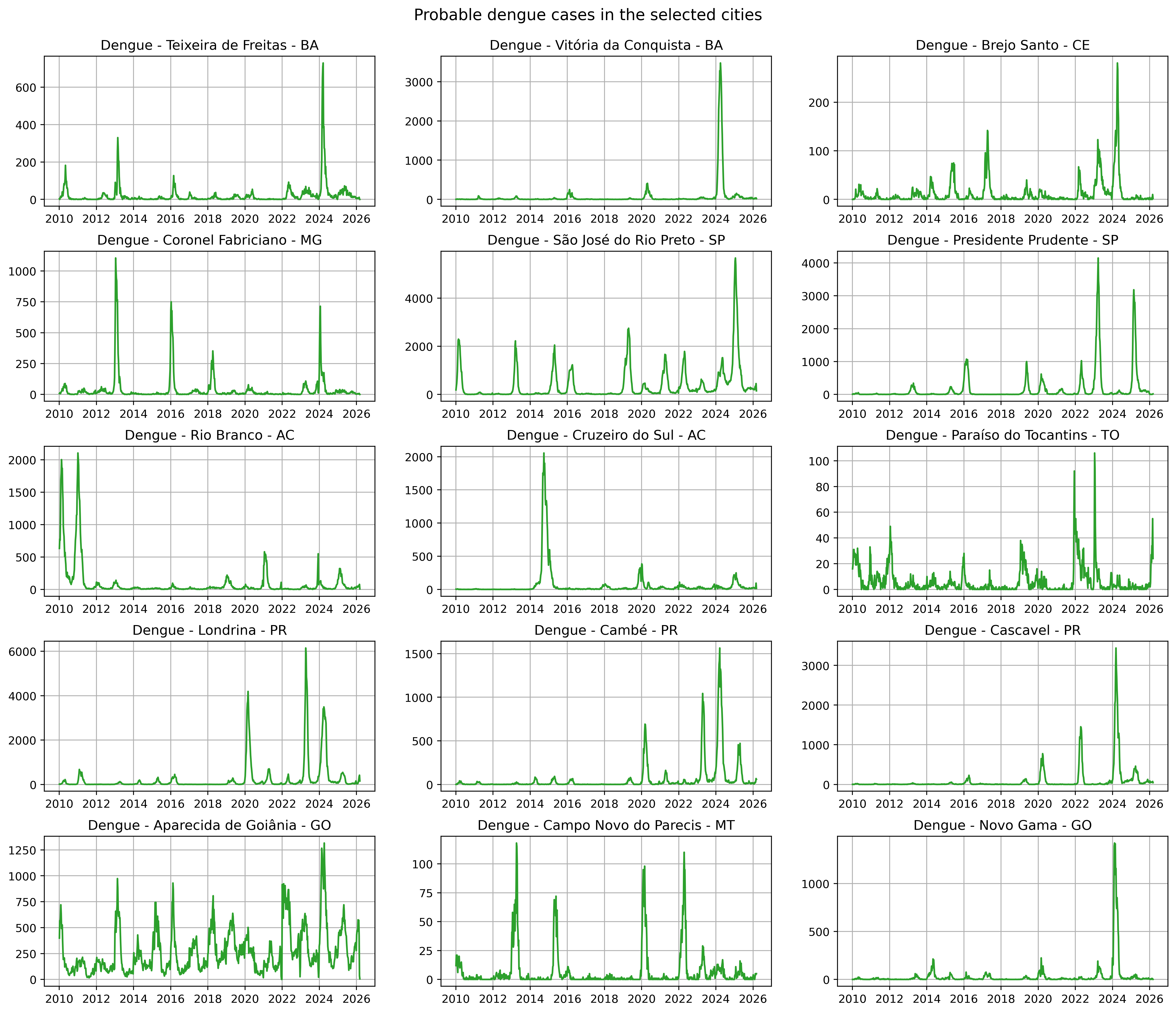
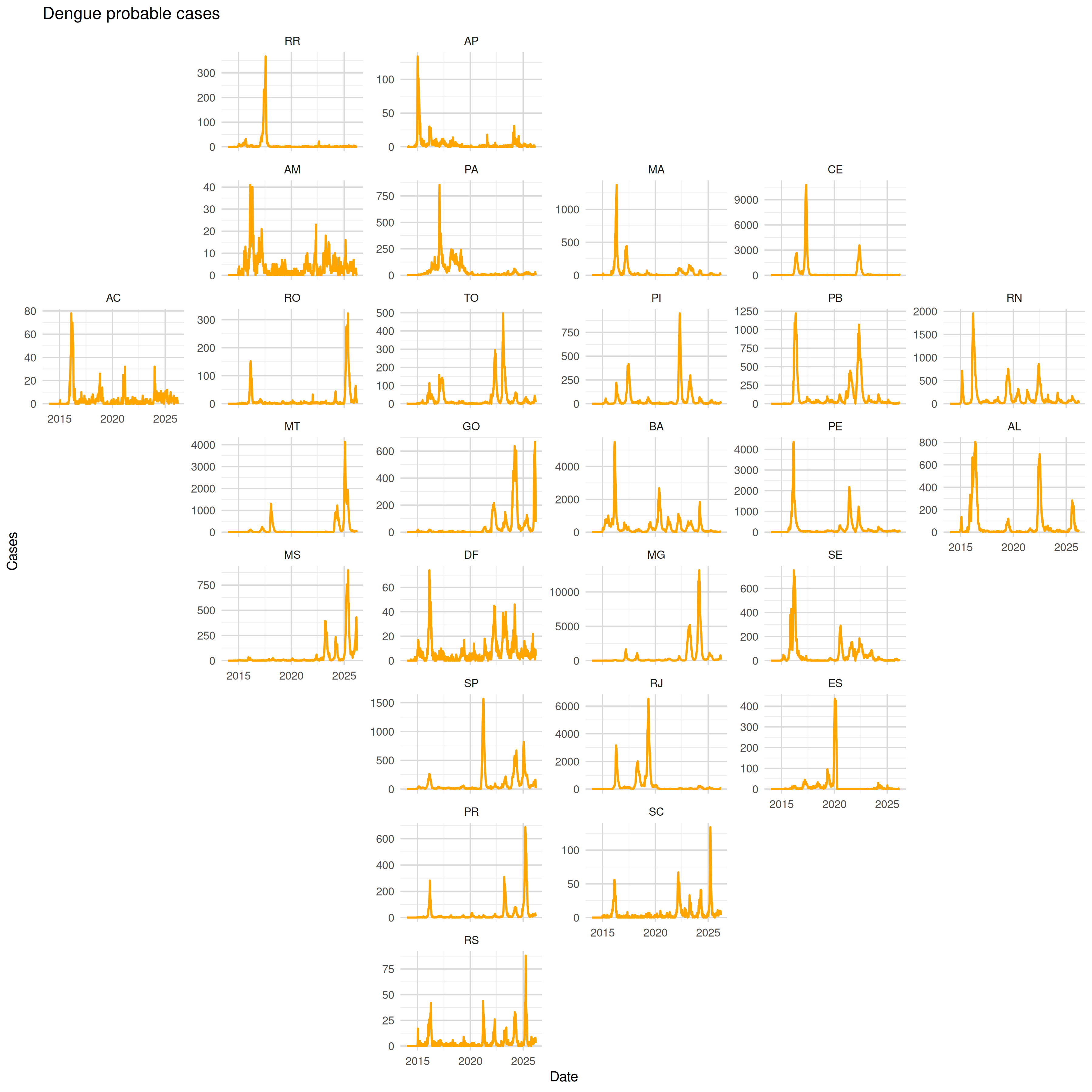
Optional Challenge 2 – Chikungunya (State Level)
Forecast chikungunya cases at the state (UF) level for all Brazilian states, except Espírito Santo.
Optional Challenge 3 – Chikungunya (City Level)
Forecast chikungunya cases for 10 selected cities.
- Teresina (PI) - geocode: 2211001
- Teixeira de Freitas (BA) - geocode: 2931350
- Montes Claros (MG) - geocode: 3143302
- Coronel Fabriciano (MG) - geocode: 3119401
- Palmas (TO) - geocode: 1721000
- Paraíso do Tocantins (TO) - geocode: 1716109
- Cascavel (PR) - geocode: 4104808
- Xanxerê (SC) - geocode: 4219507
- Cuiabá (MT) - geocode: 5103403
- Campo Novo do Parecis (MT) - geocode: 5102637
The figure below shows the time series of chikungunya cases for these cities: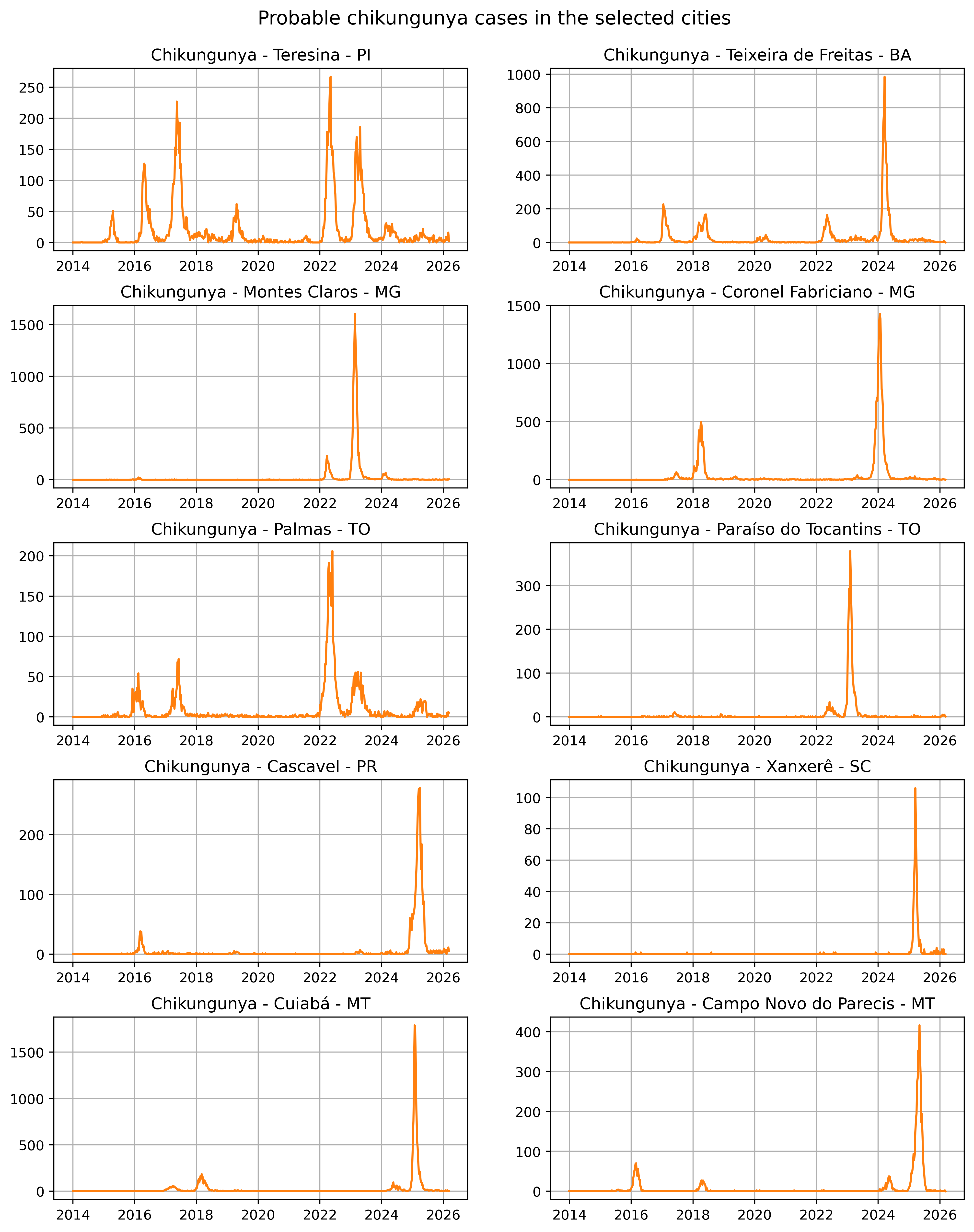
Cities included in both diseases
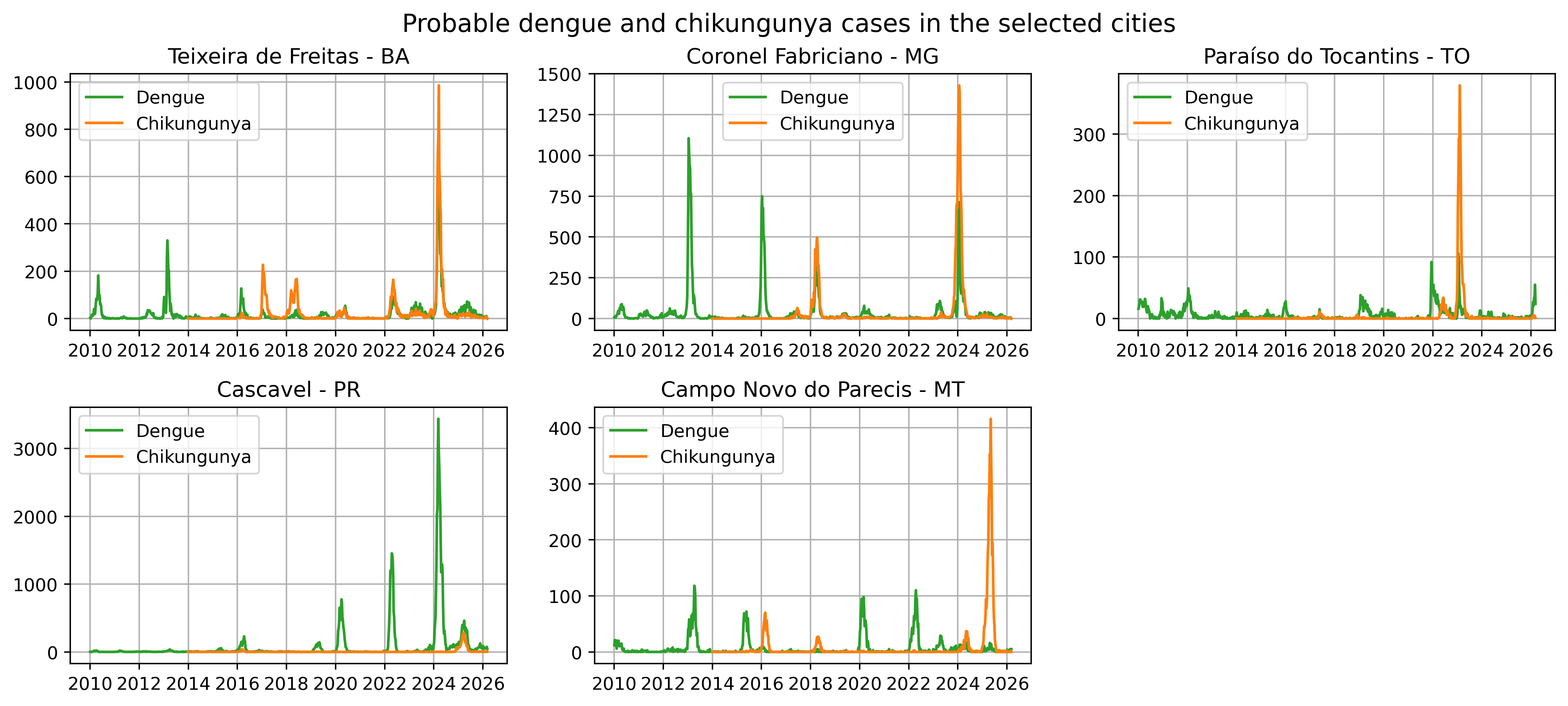
Please note that forecasts for both dengue and chikungunya were requested for the cities listed below:
- Teixeira de Freitas (BA) - geocode: 2931350
- Coronel Fabriciano (MG) - geocode: 3119401
- Paraíso do Tocantins (TO) - geocode: 1716109
- Cascavel (PR) - geocode: 4104808
- Campo Novo do Parecis (MT) - geocode: 5102637
The figure below shows the time series of chikungunya and dengue cases for the selected cities:
4. Forecasts Targets
The challenge includes four validation targets and one final forecast target. Each target corresponds to a dengue season in Brazil, defined from epidemiological week (EW) 41 of one year to EW 40 of the following year. During the validation phase, participants generate retrospective forecasts using historical data available up to a given time point. This allows model performance to be evaluated under realistic forecasting conditions. The validation targets are:
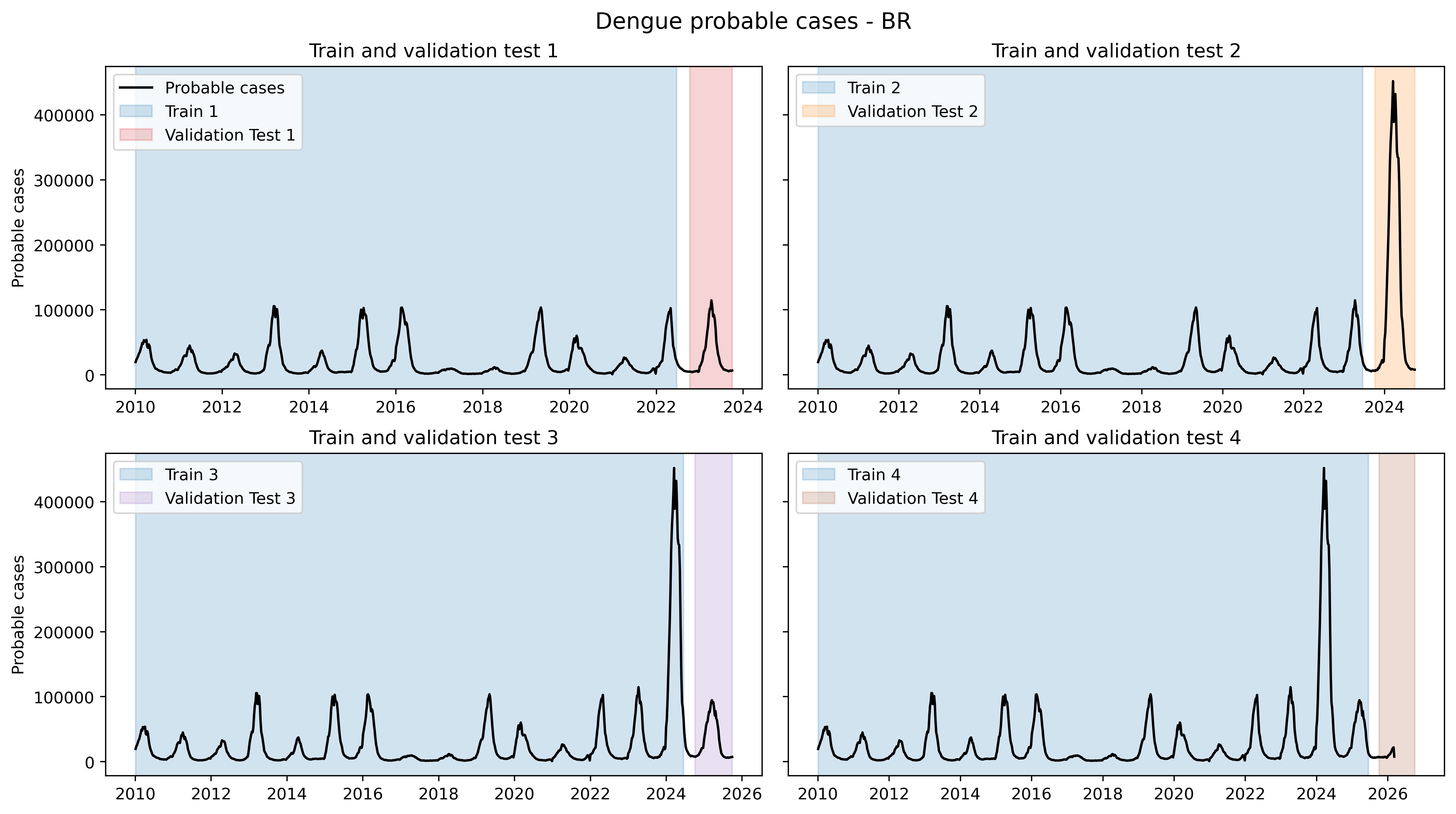
- Validation test 1: Predict the weekly number of dengue or chikungunya cases for the 2022–2023 season (EW41 2022 – EW40 2023), using data from EW01 2010 to EW25 2022.
- Validation test 2: Predict the weekly number of dengue or chikungunya cases for the 2023–2024 season (EW41 2023 – EW40 2024), using data from EW01 2010 to EW25 2023.
- Validation test 3: Predict the weekly number of dengue or chikungunya cases for the 2024–2025 season (EW41 2024 – EW40 2025), using data from EW01 2010 to EW25 2024.
- Validation test 4: Predict the weekly number of dengue or chikungunya cases for the 2025–2026 season (EW41 2025 – EW40 2026), using data from EW01 2010 to EW25 2025.
Finally, the forecast target focuses on predicting the weekly number of dengue cases for the 2026–2027 season (EW41 2026 – EW40 2027) using all data available from EW01 2010 to EW25 2026.
Forecast outputs
Models should generate the following outputs:
- Validation forecasts: predicted curves of dengue and chikungunya cases including
- median estimate
- 50%, 80%, 90%, and 95% predictive intervals.
- Forecast target: predicted curves of dengue cases including
- median estimate
- 50%, 80%, 90%, and 95% predictive intervals.
The median estimate must correspond to the 50th percentile (0.5 quantile) of the predictive distribution. Predictive intervals should be defined using the appropriate lower and upper quantiles: the 50% interval corresponds to the 25th and 75th percentiles, the 80% interval to the 10th and 90th percentiles, the 90% interval to the 5th and 95th percentiles, and the 95% interval to the 2.5th and 97.5th percentiles.
5. Model development and forecast submission
Each team develops its own forecasting model using different methodological approaches, such as:
- statistical models;
- mechanistic or epidemiological models;
- machine learning or artificial intelligence techniques.
You can take a look at the list of models submitted in previous years here.
Forecasts must be submitted in a standardized format. Check the details in the official challenge repository on GitHub. This process ensures that all forecasts can be evaluated consistently. Additionally, check out our playlist with tutorial videos for the challenge here.
6. Model evaluation
Models will be compared using predefined performance metrics. The evaluation includes:
- retrospective validation using historical data
- comparison across different forecasting methodologies
The following metric will be computed:
- Weighted Interval Score (WIS) Interval predictions will be evaluated on a weekly basis
7. Ensemble model construction
An important component of the IMDC is the creation of an ensemble model, which combines forecasts from multiple teams. This collective model typically provides more robust and accurate predictions of dengue outbreaks.
8. Dissemination of Results
Results from the challenge will be presented through:
- scientific webinars
- project workshops
- technical reports and scientific publications.
9. Calendar
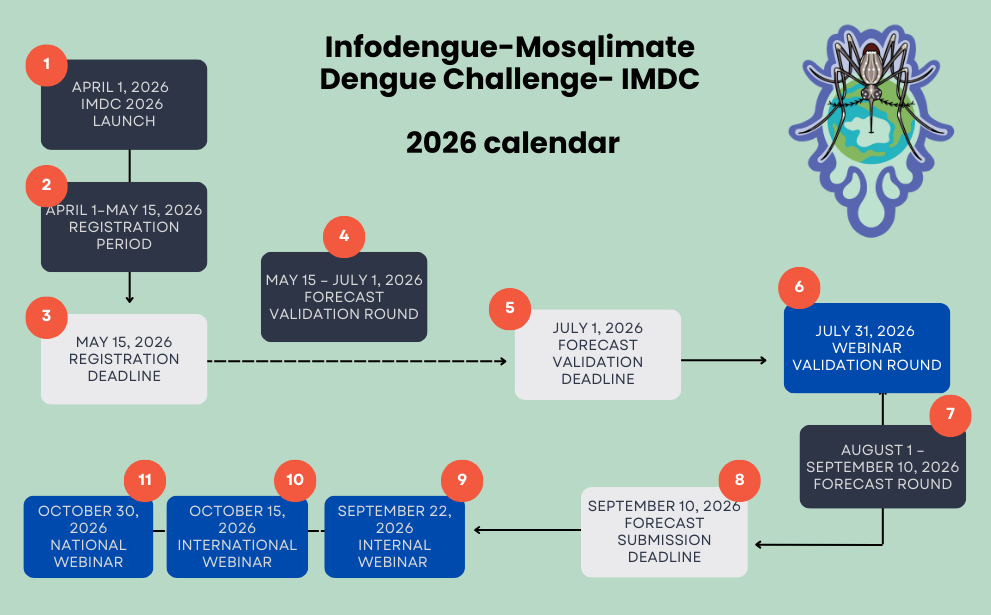
Important dates:
- April 1, 2026 – Challenge launch and opening of team registrations
- May 15, 2026 – Deadline for team registration
- July 1, 2026 – Submission deadline for validation round results
- July 31, 2026 – Webinar: Presentation of validation round results
- September 10, 2026 – Submission deadline for 2026–2027 forecasts
- September 22, 2026 – Internal webinar for teams to present model methodologies
- October 15, 2026 – International webinar: Technical results of IMDC 2026
- October 30, 2026 – International webinar: IMDC 2026 results for the general audience
10. Support and Contact
If you encounter any issues or have questions, reach out to us via:
- Discord Channel: Join the Discord
- Email: Send your queries to mosqlimate@gmail.com.